
03) PARALIMIT: A New Dimension in High-End Processing
In the last post, I showed you how HiFAL’s Main processor and PARALIMIT operate as two separate processing paths.
Now let’s dig into what makes PARALIMIT interesting.
The idea was partly inspired by an old parallel compression technique. One version of the classic Motown vocal trick was to duplicate a vocal, high-pass it, compress it heavily, and blend it back underneath the original.
The original vocal maintains its dynamics, while the compressed high-frequency layer adds clarity, presence, and density. Here is a quick video explaining the Motown approach and how it inspired PARALIMIT.
PARALIMIT applies a similar philosophy, but with acceleration limiting. It lets you isolate a specific high-frequency range, apply acceleration limiting to that band, and blend the processed signal back underneath the Main HiFAL signal.
The PARALIMIT Dynamics knob controls how much limiting and smart makeup gain is applied, and the fader controls how much of that processed signal is blended back into the mix. Changing the channel selection or Dynamics setting maintains a similar perceived level in parallel.
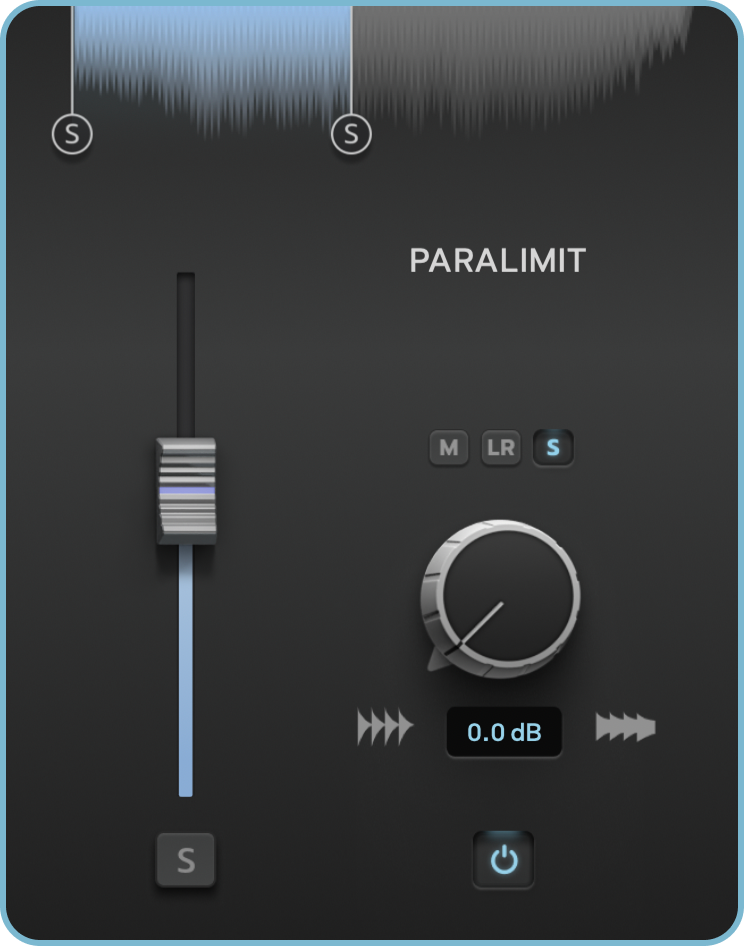
M / LR / S: Shaping the Stereo Image
Where PARALIMIT gets really interesting is its M / LR / S channel matrix.
In LR mode, PARALIMIT processes the band-isolated true Left/Right signal using 100% stereo-linked acceleration limiting, maintaining the original stereo image as you blend the processed band back into the mix.
M and S modes begin with that same process. Acceleration limiting is applied to the true Left/Right signal first. Only then is the signal converted to Mid/Side, where either the Mid or Side information is extracted and returned in parallel.
This order is important. Because the transient control happens to the true Left/Right signal before M/S extraction, the processing respects the original stereo image.
In Side mode, rather than simply turning up the Side signal, PARALIMIT first controls the high-frequency transients of the true stereo image, then extracts the resulting Side information. That controlled Side signal is blended back in parallel, adding density and width rather than simply pushing the existing Side information louder.
The result is width that can be pushed further without the plasticky, detached quality that can happen when simply increasing the Side level.
Mid mode applies the same idea toward the center. After controlling the true stereo signal, PARALIMIT extracts the Mid information and blends it back in parallel, adding density, focus, and presence to vocals and other center information without simply turning up the entire Mid channel.
M, LR, and S turn PARALIMIT into more than a parallel high-frequency limiter. They let you control not only how much high-frequency density you add, but where that density sits in the stereo image.
Try isolating the upper frequencies, selecting S, applying some acceleration limiting, and slowly bringing up the PARALIMIT fader. It has become one of my favorite ways to add width and density to high frequencies while preserving the integrity of the stereo image.
Be well,
Ryan Schwabe
Grammy-nominated and multi-platinum mixing & mastering engineer
Founder of Schwabe Digital

HiFAL 2 (High Frequency Acceleration Limiter, pronounced “High Fall”) brings a classic vinyl mastering technique into the modern era. Using an often overlooked approach to high-frequency processing, HiFAL 2 lets you shape brightness, transient detail, and stereo image as subtly or aggressively as your mix needs. Designed for the mix bus, HiFAL 2 is jsut as useful anywhere in your mix where high frequencies need attention.