04) Processing Modes
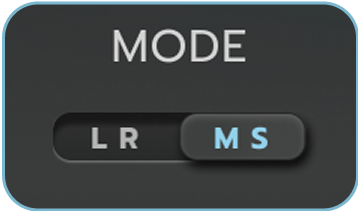
When switching processing modes, both the input meter and gain reduction meter update their labels between LR and MS.
In LR (Left/Right) mode, it’s common to keep thresholds linked since both channels usually share similar dynamics. Channel link settings can then be adjusted to control how much the channels influence each other. In MS (Mid/Side) mode, the Mid and Side signals often differ significantly in level, so unlinked thresholds are usually better for applying appropriate gain reduction to each.
In Practice:
For most applications, stereo mode with 50–85% linked thresholds is relaxed and 0% is aggressive. If you are working on particularly wide HF material, it can be helpful to use a tighter link to maintain imaging. MS mode is especially useful when controlling specific parts of the stereo image. For example, you might compress the Side channel to tame cymbals or wide high-frequency content, or compress the Mid channel to control a lead vocal or other central elements.
What is MS Processing
It’s important to understand that MS refers to Mid and Side, or more accurately, Sum and Difference, not mono and stereo. MS encoding and decoding involves simple phase-based signal combinations.
Encoding MS
Mid (M) = Left + Right
Side (S) = Left - Right (phase-inverted)
Decoding MS
Left = (M + S) / 2
Right = (M - S) / 2
The Mid channel represents what is common between left and right. The Side channel represents what is different. MS processing lets you manipulate these components directly, giving you more control over the stereo image.
Linked Average Stereo Control

The Channel Link control in HiFAL determines how the left and right channels are combined at the detection stage of the compressor.
At 0% (Fully Independent), each channel is detected and processed separately. This dual-mono behavior allows full independence but may introduce stereo image shifts if one chanel triggers more compression than the other.
At 100% (Fully Linked), HiFAL averages the peak levels of the left and right channels to create a single, shared control signal. This blended detection avoids the typical “peak-of-either” method, where a loud transient in one channel can dominate compression. Instead, it provides smoother, more balanced dynamic control across the stereo field.
At values between 0% and 100%, HiFAL blends between independent and linked detection, allowing for precise control over stereo cohesion.
This "average peak" rather than "peak of either" approach keeps the stereo image stable while maintaining musical responsiveness, especially on wide or asymmetrical material.

In Practice:
The interaction between the Processing Modes and Channel Link allows for smooth compression while preserving the stereo image. I work in stereo mode for about 90% of my mixes and masters, usually keeping the Channel Link setting at 50-85%. If I notice intense fluctuations in the stereo image, I move the dial closer to 100% linked to maintain the stereo image in the high frequencies. In MS mode, the Mid and Side information is decontextualized from one another and you generally do not want the sum ducking the difference. For this reason, the plugin includes logic that automatically switches to fully independent compression in MS mode to preserve the unique dynamics of each channel.
Be well,
Ryan Schwabe
Grammy-nominated and multi-platinum mixing & mastering engineer
Founder of Schwabe Digital