
HiFAL is a tool designed to control the tonality, shape, and balance of the high frequencies in your mix.
When deciding where to place HiFAL on the mix bus, it helps to think about how loudness affects balance. As a master gets louder, the mix often feels brighter. This tonal change is dynamic, driven by how loudness processing reshapes high frequency energy in relation to the low end.
Recommended Mix Bus Placement
In most mixes, I place Gold Clip or Orange Clip first, then HiFAL, either early in the chain or directly before the final limiter.
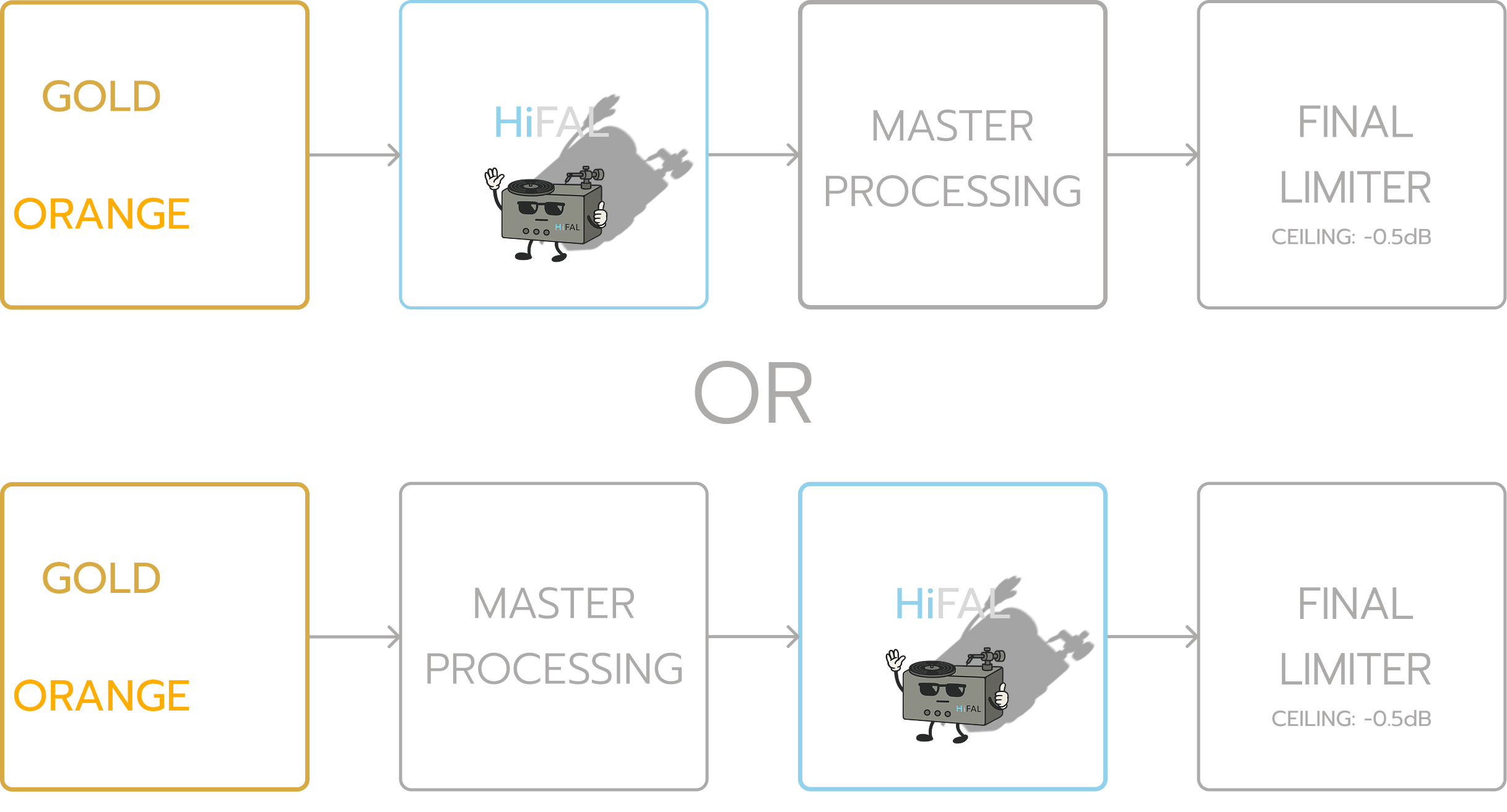
Putting Gold Clip first allows me to reduce peaks, increase loudness and gain stage the mastering chain. Placing HiFAL after Gold Clip helps manage brightness in two ways. First, HiFAL’s gain reduction adaptively controls high frequency energy, keeping the top end smooth and natural as it feeds into the limiter. Second, the trim knob acts as a tone control, allowing you to tune the relationship between the highs and the lows before final limiting. If limiting starts to make the mix feel brighter, you can pull back on loudness or use the trim control to rebalance the high end.
Alternative Placement

In some cases, I sandwich two limiters and use the headroom between them to manipulate peaks in the master. I often use this approach instead of true peak limiting, since true peak limiters make decisions based on predicted overshoot, which has never sounded particularly musical to me. I have found that managing peaks directly with this dual limiter approach produces more predictable results.
The first limiter handles all gain reduction for loudness and runs with a lower ceiling, around -0.5 dB. The second limiter is set higher, around -0.1 dB, and simply catches any peaks created by the processing between the two limiters. It does not add gain and functions only as a protection limiter.
The two limiters create a small window of headroom where I can add additional processing. I sometimes place HiFAL in this window to control any brightness introduced by the first limiter. I often use other processors there as well, and some of those techniques are discussed in the video above.
Buy or get your Free Trial of HiFAL below



Why This Placement Works
As loudness increases, low frequency energy from the kick and bass tends to dominate the limiter, driving gain reduction across the entire signal. When those low frequency hits end, the limiter releases and the mids and highs swell forward. Over time, this repeated reduction and release shifts the perceived balance. The mix can feel brighter and more fatiguing even though no additional high frequency content is being added. The harshness we get from loudness process is not always distortion. It is a shifting sense of brightness caused by gain reduction releasing after low frequency hits.
If you think of a full band limiter as an automated volume fader, where the entire mix is turned down during bass hits and then turned back up after them, this behavior becomes much easier to understand.
How to Set HiFAL
I suggest setting the threshold during an average loudness section of the song, such as the first chorus. Adjust the threshold until the 0 to 1 dB gain reduction bulb gently pulses. At this level of gain reduction, the attack and release are extremely slow, around 300 ms. When louder sections hit or high frequency elements like vocal consonants, hi hats, or crashes stack up, you should see short bursts of faster limiting in the 2 to 6 dB range, followed by a quick return to the 0 to 1 dB range.
No Rules
There are no strict rules for where HiFAL goes in the chain. I think of it as a do no harm processor when it is set correctly. It can work anywhere as long as you approach it differently than a traditional dynamic processor.
HiFAL works best when it is using its full acceleration window. Most of the time, it should be doing little to no gain reduction. In that state, it behaves very slowly and does not affect any transients. When fast high frequency transients appear, it briefly accelerates and applies control only where needed.
This is different from how compressors are usually set, where gain reduction moves most of the time and reinforces rhythmic motion. With HiFAL, gain reduction should stay near zero until it briefly accelerates into fast limiting, reaching around 2 to 6 dB. It then quickly returns to zero and a very slow state that lets natural transients pass through.
HiFAL sounds its best when it stays out of the way most of the time and only steps in when needed, providing transparent control without changing the feel of the mix.
If you want to learn more about HiFAL check out the 11 part video series below.
Tag me on my @SchwabeDigital instagram and let me know what you think..
Be well,
Ryan Schwabe
Grammy-nominated and multi-platinum mixing & mastering engineer
Founder of Schwabe Digital














Shaping high frequencies is one of the more challenging aspects of mixing and mastering, especially when the changes are subtle. Small adjustments to high-frequency dynamics can have a significant impact on how we perceive the overall sound of a record.